RESEARCH BY Richmond Dutton
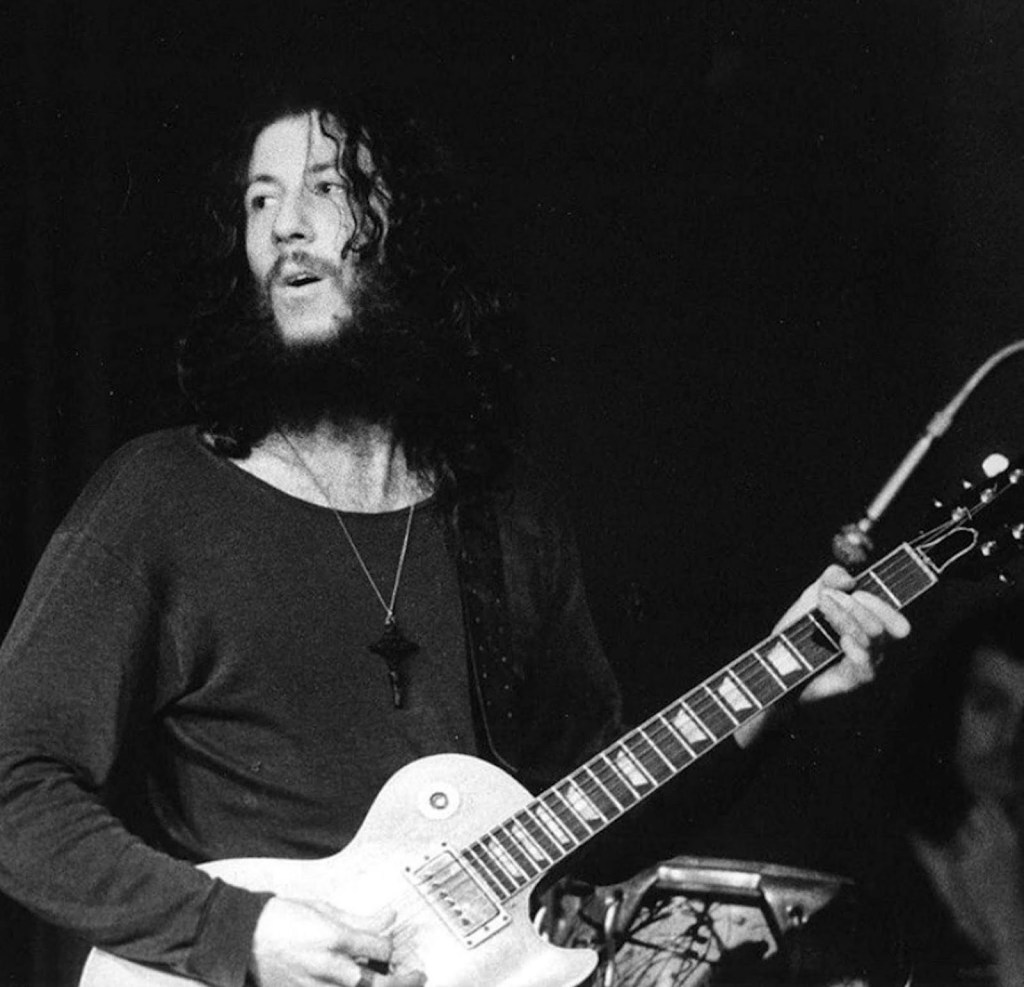
PETER GREEN
Peter Allen Greenbaum was born in Bethnal Green, London, on 29 October 1946 .He was the youngestfour children and it was his brother, Michael, who started him off playing the guitar and by the age of 15 he was playing professionally firstly played bass guitar in a band called Bobby Dennis and the Dominoes a cover band. He went on to join a rhythm and blues band called the Muskrats, & then the Tridents playing bass. But by 1965 Green was playing lead guitar in “Peter B’s Looners”, and this is where he met drummer Mick Fleetwood. It was with Peter B’s Looners that he made his recording début with the single “If You Wanna Be Happy” with “Jodrell Blues” as a B-side.He also recorded an instrumental cover of the Jimmy Soul number “If You Wanna Be Happy”
From 1966–1967 he joined John Mayall and the Bluesbreakers replacing Eric Clapton on lead guitar . When asked “Where’s Eric Clapton?” Mayall answered, “He’s not with us anymore, but don’t worry, we got someone better.”
His recording debut with the Bluesbreakers in 1967 was on the album A Hard Road which featured two of his own compositions, “The Same Way” PLAY !!! and “The Supernatural” PLAY .
Green DECIDED to form a new blues band of his own in 1967. It was was initially called “Peter Green’s Fleetwood Mac featuring Jeremy Spencer”. Within a month they played at the Windsor National Jazz and Blues Festival in and were signed up to the Blue Horizon label. Their repertoire consisted mainly of blues covers and some originals, mostly written by Green, but some were written by slide guitarist Jeremy Spencer. The band’s first single had Jeremy Spencer’s “I Believe My Time Ain’t Long” with Green’s “Rambling Pony” as a B-side. PLAY !!!
Classic blues covers were foremost in the band’s repertoire through this period, but Green contributed many successful original compositions from 1968 onwards. The songs chosen for single release showed Green’s style gradually moving away from the group’s blues roots into new musical territory.In 1968 they scored a hit with Green’s “Black Magic Woman” PLAY !! (later covered by Santana), followed by the guitar instrumental “Albatross” PLAY !!! (1969), which reached number one. More hits written by Green followed, including “Oh Well” PLAY !!! , and the ominous “The Green Manalishi” (1970) PLAY!!! .The double album Blues Jam in Chicago from 1969 was recorded at the Chess Records Ter-Mar Studio in Chicago. There, under the joint supervision of Vernon and Marshall Chess, they recorded with some of their American blues heroes including Otis Spann, Big Walter Horton, Willie Dixon, J. T. Brown and Buddy Guy.
Around the time of the release of “Man of the World” in 1969, Green’s friends started to notice changes in him. PLAY MAN OF THE WORLD . He had begun taking LSD and whilst on a 1970 European tour he took LSD at a party at a commune near Munich . Fleetwood Mac manager Clifford Davis cites this as the crucial point in Green’s mental decline. Green would not leave the commune, so Mick Fleetwood and others had to go there to fetch him. After a final performance on 20 May 1970, Green left Fleetwood Mac.
After leaving Fleetwood Mac , in the summer of 1970 Green appeared at the Bath Festival of Blues and Progressive Music with John Mayall and later that year he recorded a jam session with drummer Godfrey Maclean, keyboardists Zoot Money and Nick Buck, and bassist Alex Dmochowski In 1971, he had a brief reunion with Fleetwood Mac, helping them to complete a U.S. tour after guitarist Jeremy Spencer had left the group, performing under the pseudonym Peter Blue.He recorded two tracks for the album Juju with Bobby Tench’s band Gass, followed by sessions with B.B. King in London in 1971 . At this time, Green’s mental illness and drug use had become entrenched and he faded into professional obscurity.
In 1974 Green was diagnosed with schizophrenia and spent time in psychiatric hospitals undergoing electroconvulsive therapy during the mid-1970s.In 1977, Green was arrested for threatening his accountant David Simmons with a shotgun. The exact circumstances are the subject of much speculation, the most famous being that Green wanted Simmons to stop sending money to him. In the 2011 BBC documentary Peter Green: Man of the World, Green stated that at the time he had just returned from Canada needing money and that, during a telephone conversation with his accounts manager, he alluded to the fact that he had brought back a gun from his travels. His accounts manager promptly called the police, who surrounded Green’s house.
In 1979, Green began to re-emerge professionally. With the help of his brother Michael, he was signed to Peter Vernon-Kell’s PVK label, and produced a string of solo albums starting with 1979’s In the Skies.
In 1981, Green contributed to “Rattlesnake Shake” and “Super Brains” on Mick Fleetwood’s solo album The Visitor.
In 1988 Green was quoted as saying: “I’m at present recuperating from treatment for taking drugs. It was drugs that influenced me a lot. I took more than I intended to. I took LSD eight or nine times. The effect of that stuff lasts so long … I wanted to give away all my money … I went kind of holy – no, not holy, religious. I thought I could do it, I thought I was all right on drugs. My failing!”
Along with the other members of Fleetwood Mac, Green was inducted into the Rock and Roll Hall of Fame in 1998.
Green formed the Peter Green Splinter Group in the late 1990s, with the assistance of Nigel Watson and Cozy Powell. The group released nine blues albums, mostly written by Watson,[2] between 1997 and 2004. In 2004 Green left the band and moved to Sweden. In February 2009, Green began playing and touring again, this time as Peter Green and Friends.
he lived for a period on Canvey Island, Essex, where he died on 25 July 2020 at the age of 73.
 Wirral Blues Club
Leave a comment